 |
| Adriana Lima |

Saturday, January 31, 2015
New Eyewear from Vogue


Friday, January 30, 2015
1-800 Contacts Starts New Battle in Mississippi
About two weeks ago, 1-800 Contacts asked the stare legislature of Oregon to look into the pricing policies of contact lens suppliers. It's doing the same in Mississippi as reported in the Clarion-Ledger:
A major online seller of contact lenses wants Mississippi to adopt a law to prevent suppliers and manufacturers from setting a minimum price for them.Read more.
1-800-Contacts, a supporter of Senate Bill 2016, says Johnson & Johnson Vision Care implemented a new pricing strategy last year that requires a minimum price for some of their contact lenses.
The Senate Public Health and Welfare Committee conducted a public hearing today on the bill, hearing from both 1-800-Contacts officials and officials of Johnson & Johnson.
Johnson & Johnson says the unilateral pricing policies will lead to lower prices for consumers.1-800-Contacts says the pricing strategy is leading to higher prices for consumers that will continue to increase.
Thursday, January 29, 2015
Cost of Living Rises 25% for People with Sight Loss
“People with sight loss can face at least 25% higher costs for everyday living than those who are fully sighted, according to a new study released by the sight loss charity Thomas Pocklington Trust,” reports Medical News Today. “For the first time, the methods used to calculate Minimum Income Standards (MIS) were applied to the living costs of people with disabilities. The research looked at sight loss and hearing loss and showed clearly that both impairments lead to substantial extra costs if a minimum acceptable standard of living is to be reached.” Read more.
Wednesday, January 28, 2015
OpticalCEUs to Host Its Annual Spring Continuing Education Program for Opticians

Prevent Blindness Launches Low-Vision Aid Purchasing Program Online

New Eyewear Collection from Emilio Pucci

New Sunglasses from Eastern States Eyewear

Tuesday, January 27, 2015
New Eyewear from Miu Miu

Sunday, January 25, 2015
1-800 Contacts Fights in Oregon for No Minimum Pricing
"An Internet firm that sells contact lenses is trying to persuade
Oregon legislators to stop manufacturers from setting a minimum price on
their products," reports Oregon Online. "The Internet firm 1-800 Contacts says a new pricing strategy by major
contact lens manufacturers is driving up prices to consumers. In recent weeks, the Utah-based firm has distributed $24,000 in political contributions
to 19 Oregon legislators as part of a lobbying effort to change the law
in about a dozen states and force the manufacturers to reverse course." Read more.
Saturday, January 24, 2015
Studying the Blind to See the 21st Century
“Studying the brain activity of blind people, scientists are challenging the standard view of how the human brain specializes to perform different kinds of tasks, and shedding new light on how our brains can adapt to the rapid cultural and technological changes of the 21st Century.” That’s the abstract from Science Daily. Read more.
New Way of Examining a Toddler’s Eyes
“Picture a toddler getting his first eye exam. He's seated in a strange room, with strange instruments and strange bright lights. He can't sit still or open his eyes long enough for that diagnostic poof of air -- especially if he has trouble seeing anyway, as children with achromatopsia do,” reports Science Daily. “But according to research from the Baylor Visual Function Testing Center, future little ones might not have to squirm in their seats during routine eye exams. The research, which was published in JAMA Ophthalmology, explores a new non-invasive technology that's kind of like a handheld CT scanner for the eye. The technology, known as spectral-domain optical coherence tomographic imaging (SD-OCT), helps pediatric ophthalmologists detect achromatopsia by studying retina thickness. It can scan the structure of the eye from a distance, without getting too close to the young patient.” Read more.
Number of Individuals and Treatment Costs for AMD to Rise Dramatically by Middle of Century
The number of individuals with age-related macular degeneration (AMD) will jump from two million to 3.4 million by 2032 and 4.4 million by 2050, according to the recent Prevent Blindness report called “Future of Vision: Forecasting the Prevalence and Costs of Vision Problems.” Treatment costs now run $4.9 billion a year, but they will increase to almost $10 billion in 2032 and $14 billion in 2050.The report notes that the current average age of AMD patients is 80. As a greater number individuals live beyond 80, the number of patients with AMD will increase. Whites and women, who are at higher risk for AMD than other groups, will continue to dominate the total affected population with AMD. Read more.
Intel Buys Swiss Smart Eyewear Startup
“Just as Google has stepped back from making networked eyewear, Intel is stepping into the gap with the purchase of Swiss startup Composyt Light Labs for an undisclosed amount,” according to a post on ZDNET. “A spinoff of the famous Swiss Federal Institute of Technology (École Polytechnique Fédérale de Lausanne, known as the EPFL), the company creates smart glass technology that can work with any type of eyewear. For its initial designs, the startup uses an ultra-miniature laser projector (developed by another EPFL start-up Lemoptix) built into the frame of the glasses. This projects images onto a transparent lens, which has a holographic film coating that reflects the information towards the eye.” Read more.
New Eyewear from Esprit

Wednesday, January 21, 2015
Calcium Deposits Possible Source of Macular Degeneration (AMD)
"New research from scientists at the University of Maryland School of Medicine (UM SOM) has found that tiny lumps of calcium phosphate may be an important triggering factor for age-related macular degeneration (AMD), a degenerative eye disease that can cause severe vision loss and blindness," reports Medical News Today. "This is the first time these mineral deposits have been implicated in the disease, which affects more than 10 million Americans. The article appeared in the latest issue of the Proceedings of the National Academy of Sciences." Read more.
New Eyewear from Elle

New Eyewear from Prada

Monday, January 19, 2015
Gene Tied to Retinitis Pigmentosa Discovered
“An exhaustive hereditary analysis of a large Louisiana family with vision issues has uncovered a new gene tied to an incurable eye disorder called retinitis pigmentosa, according to an examination led by scientists at The University of Texas Health Science Center at Houston (UTHealth). It is a family of eye diseases that affects more than 200,000 in the United States and millions worldwide,” according to a Science Daily post.
“In the journal Investigative Ophthalmology & Visual Science, UTHealth's Stephen P. Daiger, Ph.D., and his colleagues report their discovery of a new gene tied to retinitis pigmentosa, which brings the total of genes associated with this sight-threatening disease to more than 60. The gene is called hexokinase 1 (HK1).” Read more.
Saturday, January 17, 2015
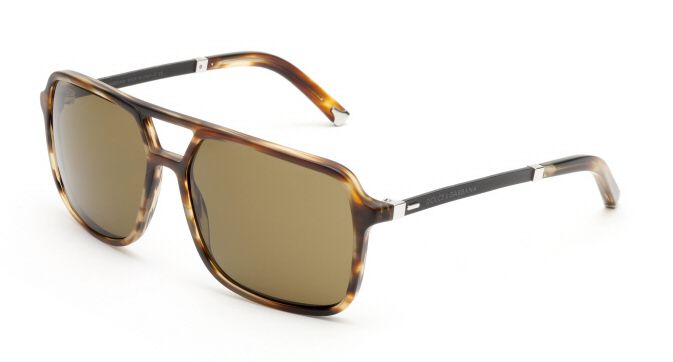
New Eyewear from Dolce & Gabbana
Friday, January 16, 2015
Eyewear Does Make You Look Smart
That’s the essence of a report that appeared a few days ago in the Wall Street Journal (see video). Here’s some of the text:
While trying to look intelligent, a lot of people do things that make them look dumb. For instance, people use big words or put on a poker face—tactics that can backfire for some, studies show. A growing amount of research is teasing out how people form first impressions of others’ intelligence—and how well it works when you try to manage those impressions. The cues people look for in assessing each other’s intelligence are simple. But they aren’t always easy to pull off under pressure. They include showing self-confidence, speaking clearly and smoothly, and responding thoughtfully to what others are saying, research shows. …Some simple stereotypes about intelligence can also shape others’ first impressions. Wearing eyeglasses can lead strangers to regard you as more intelligent, says a 2011 study in the Swiss Journal of Psychology.The Atlantic Monthly ran a similar article back in August. You might want to give that a glance as well. Think of it as marketing research. With this type of information, which is all supported by social science research, you have more information to offer your patients and customers.
Subscribe to:
Posts (Atom)