Showing posts with label Safety. Show all posts

Wednesday, April 23, 2014

Safety Eyewear Market Increasing—Slowly

Over the five years to 2014, Protective Eyewear Manufacturing industry revenue is expected to grow at an annualized rate of 2.8% to $555.5 million, including an increase of 3.4% in 2014. The American Optometric Association estimates that 90.0% of these injuries could be reduced or prevented with the use of proper eye protection. The number of industry operators is estimated to increase at an average annual rate of 0.8%. Growth in the number of companies has been subdued due to major acquisition activity by the industry's largest players, 3M Company and Honeywell International Inc. Additionally, high manufacturing costs and rising prices for plastic materials have created an industry in which almost half of domestic demand is supplied through imports. Over the next five years, imports are expected to continue growing as domestic manufacturers focus on higher value-added products with increased functionality and design elements. Rising domestic demand will enable revenue to grow at a robust rate over the five years to 2019. Read more.

Saturday, March 8, 2014

The Importance of Wearing Eye Protection

March is National Save Your Vision Month, and the Defense Department wants service members to take care of their eyes by wearing eye protection when performing dangerous work, reducing eye strain and routinely undergoing eye examinations. That's the word from the DOD.
Click photo for screen-resolution image
In this Feb. 6, 2006, file photo, U.S. Army 1st Lt. Anthony Aguilar wears the ballistic protective eyewear that prevented a bomb fragment from possibly damaging his eyes when an improvised explosive device detonated near his Stryker vehicle while on patrol in Mosul, Iraq. U.S. Army photo
  

(Click photo for screen-resolution image);high-resolution image available.
Dr. Robert Mazzoli, an ophthalmologist at the Vision Center of Excellence at Madigan Army Medical Center in Tacoma, Wash., noted the Iraq and Afghanistan wars of more than a decade produced a historic high in the percentage of eye injuries.
“When we were first going into Iraq, eye injuries accounted for 25 percent of all combat casualties,” he said. “That's because people weren't wearing their eye protection.”

On April 6 at Foxwoods Resort and Casino, OpticalCEUs founder Linda Conlin discusses in greater depth the role of contact lenses and eyewear protection in the workplace.

Her course “Contact Lenses on the Job” will address the advantages and disadvantages of contact lens wear in a variety of work environments, show when contact lenses are appropriate and provide instruction on how to respond to contact lens wear-related problems in the workplace.

Want to learn more? Get your ABO/NCLE credits by reserving your spot at our spring conference. Register now!

Monday, March 3, 2014

Safety First! How Eye Care Pros Can Prevent Workplace Injuries

The workplace isn’t a safe place for eyes. Every day, 2,000 Americans suffer a job-related eye injury that requires treatment, according to the Centers for Disease Control.

Flying particles and contact with chemicals are responsible for nine in 10 of those injuries mainly because people wear the wrong eye protection or none at all.

The solution may seem simple - wear protective goggles - but contact lenses also can play a big role in workplace eye safety. They're not a suit of armor for eye, but they can improve worker safety (and increase productivity).

Wearing contact lenses provides a wider field of vision and reduces distortion. They also allow workers to work more comfortably while wearing the proper protective eyewear.

As eye care professionals, taking the time to ask patients about their jobs, advising them on the benefits and limitations of contact lenses, and teaching them eye irrigation techniques can go a long way in saving their vision.

While
you’re at it, asking about their hobbies and home chores can significantly reduce injuries. Home repairs, cleaning, cooking, yard work, and other domestic activities result in more than 40 percent of all eye injuries. Another 40 percent is the result of sports and recreation.

Because of new designs and materials, contact lenses have an expanding demographic. On April 6 at Foxwoods Resort and Casino, OpticalCEUs founder Linda Conlin discusses in greater depth the role of contact lenses in the workplace.

Her course “Contact Lenses on the Job” will address the advantages and disadvantages of contact lens wear in a variety of work environments, show when contact lenses are appropriate and provide instruction on how to respond to contact lens wear-related problems in the workplace.

Want to learn more? Get your ABO/NCLE credits by reserving your spot at our spring conference. Register now!

Friday, January 3, 2014

New Safety Eyewear from Honeywell

“Honeywell Safety Products has launched the new North brand GX-8 series ofsafety eyewear,” according to the post on Safety Online. “The semi-frameless style features sleek, nickel-free, brushed steel frames for a sophisticated look, and 8-base wraparound lenses for optimum coverage and protection. Available in five lens tints and with optional Fog-Ban coating, the GX-8 delivers superior versatility to protect workers’ eyes in nearly any application.” Read more.

Saturday, September 14, 2013

3M Adds Scotchgard Anti-Fog to Safety Eyewear

“3M takes safety eyewear to the next level by adding Scotchgard Anti-Fog Coating. The proprietary coating provides at least 12 times longer lasting fog resistance than traditional anti-fog coatings to help increase eyewear performance in rugged, dusty, steamy and wet work environments. Scotchgard anti-fog coating retains its effectiveness for at least 25 washings with water, allowing workers to wear the lens longer, which may result in lower cost,” reports Safety Online. “Scotchgard anti-fog coating is available in four styles of 3M safety eyewear: Maxim Spectacles, Maxim Plus Dust Goggles, Lexa Dust Gogglegear Safety Goggles (med. & lg.) and Lexa Splash Gogglegear  Safety Goggles (med. & lg.). …All styles meet the requirements of CSA Z94.3-2007 and ANSI Z87.1-2010.” Read more.

Thursday, August 15, 2013

Revision Military Gets Swiss Army Eyewear Contract

Revision Military has landed “a 5-year contract to supply the Swiss Armed Forces with its protective eyewear needs,” says the Ottawa Citizen. “Following extensive user trials and meeting stringent performance requirements, Revision’s Sawfly Eyewear was selected as the all-purpose ballistic spectacle of choice. Beginning January 2014, it will become the standard issue spectacle to all Swiss troops—to the tune of 290,000 Sawfly Military Eyewear kits plus additional accessories. This is Revision’s second eyewear contract with the Swiss Armed forces; in 2008 they were awarded a contract to supply 10,000 Desert Locust Military Goggles.” Read more.

Tuesday, June 4, 2013

New Safety Eyewear from Honeywell

“Honeywell Safety Products has unveiled Uvex Pheos safety eyewear, which combines streamlined styling with technologically advanced materials to deliver high-performance protection. The eyewear’s frameless design features duo-spherical lenses for unparalleled optical quality and superior all-around coverage,” according to Utility Products. “The dielectric style comes with Uvex Dura-streme dual action anti-fog, anti-scratch coating for exceptional versatility and value. Available in two sizes and three lens tints, Uvex Pheos is designed to fit the workforce and perform to perfection in nearly every application.” Read more.

Wednesday, April 24, 2013

New Safety Eyewear from Honeywell

“Safety eyewear: Honeywell Safety Products has introduced two new styles of protective eyewear, Conspire and Relentless,” according to Utility Products. “Both feature the exclusive new North Signature Fit profile, specially designed to comfortably fit at least 85% of wearers right out of the box without the need for advanced adjustments. Given their combined protective qualifications, lightweight design and adjustment-free fit, Conspire and Relentless deliver extreme value to safety managers by simplifying the safety eyewear purchasing process.” Read more.

Wednesday, June 20, 2012

20 Work Days of Fog-Free Safety Eyewear Now Available
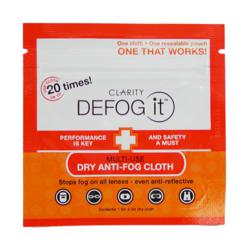
A new cloth from Defog It reportedly offers up to 20 work days of fog-free safety eyewear.  With the new resealable pouch, a worker can use a single Defog It cloth to give lenses up to 8 hours of fog-proofing, return it to a foil pouch, and zip it closed to use again as many as 20 times.Read more.

Wednesday, September 28, 2011

New Regs Boosts Eye Safety Sales; Bad Economy Pulls Them Down

"The protective eyewear industry thrives off of workplace safety regulations," says DailyMarkets. "The most recent revision to standards in 2010 is expected to boost revenue as employers comply with the new rules. However, revenue growth depends highly on industrial, construction, and healthcare activity. Hence, the economic downturn of recent years that slashed employment across the economy pulled down demand for industry products. Revenue fell in 2008 and 2009, but it returned to growth in 2010 along with rising industrial activity and strong healthcare demand. Over the five years to 2011,revenue in the protective eyewear industry is expected to grow at an average annualized rate of 1.1 percent to $529.2 million, including an increase of 3.1 percent in 2011, said IBISWorld analyst Brian Bueno." Read more.

Sunday, July 10, 2011

Wilexy Offering ANSI Standard Wraps

Wiley X Eyewear Style: Slay (7_11)
"Wiley X Eyewear offers its popular Slay™ Active Series model with polarized smoke gray lenses and glass black frames," notes EyeSurf. "Wiley X’s advanced Filter 8 polarized lenses eliminate reflective glare, improve visual contrast and protect the wearer’s eyes against 100-percent of harmful UV rays....[T]he new Slay exceeds Ansi z87.1-3003 high velocity and high mass impact certification standards." Read more.

The blog adds that Wiley "has added the new Curve to its innovative Climate Control Series — bringing exceptional protection, comfort and visual acuity to youth, women, and men with narrow facial structures." Read more.

Saturday, July 9, 2011

Sales Opportunity Comes from Eye Safety

MedicalXPress asks, "Did you know that the American Academy of Ophthalmology estimates that more than two-million occur each year in the United States and that 45 percent of these injuries happen in the home, with another 40 percent being coming from sports or recreational activities? And of all these injuries, 90 percent are preventable. Yet only 35 percent of those who experienced an eye injury were wearing glasses, with only about 5 percent wearing glasses specifically designed for safety....It is for this reason that the American Academy of Ophthalmology and the American Society of Ocular Trauma recommend that every household have at least one pair of American National Standards Institute (ANSI)-approved protective eyewear to be worn when participating in any activity that could create a risk for an eye injury, including the use of hazardous chemicals, flying debris or projectiles to both the participant and any bystander." Also represents a sales opportunity. Read more.

Tuesday, December 14, 2010

Take Care Driving. Your Customers Ain't Wearing Their Glasses

A recent survey commissioned by Essilor of America, Inc.,revealed 20 percent of eyeglass wearers sometimes drive without their prescription glasses and instead wear non-prescription sunglasses, making day-driving unnecessarily treacherous.

Wednesday, December 8, 2010

Avoidable Eye Injuries Cost $300 Million Annually

Each day many workers "bypass" vision safety precautions. At the end of the day, almost 2,000 are going to the hospital or home with eye injuries that were avoidable, according to a new study from The Vision Council and the American Society of Safety Engineers (ASSE). The study, called Eye Safety At-a-Glance: Protecting Your Vision at Work, notes that those injuries cost American business about $300 million annually in medical bills, compensation and downtime but not including lost productivity.  The study also points out that private industry employees lose about 27,000 days at work--never mind the time they lose with their families as they recuperate.