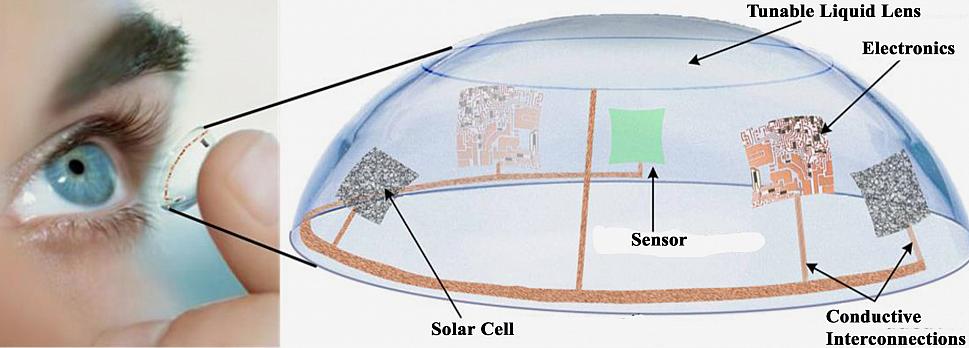
| Contact lens designed for presbyopia |
Showing posts with label NIH. Show all posts
Tuesday, March 15, 2016
Using Fish and Insects to Design Contact Lenses
Wednesday, August 26, 2015
Omega-3 Supplements Don't Help with Age-Related Macular Degeneration, Says NIH Study
While some research suggests that a diet high in omega-3 fatty acids can protect brain health, a large clinical trial by researchers at the National Institutes of Health found that omega-3 supplements did not slow cognitive decline in older persons. With 4,000 patients followed over a five-year period, the study is one of the largest and longest of its kind. It was published today in the Journal of the American Medical Association. “Contrary to popular belief, we didn’t see any benefit of omega-3 supplements for stopping cognitive decline,” said Emily Chew, M.D., deputy director of the Division of Epidemiology and Clinical Applications and deputy clinical director at the National Eye Institute (NEI), part of NIH. Dr. Chew leads the Age-Related Eye Disease Study (AREDS), which was designed to investigate a combination of nutritional supplements for slowing age-related macular degeneration (AMD), a major cause of vision loss among older Americans. That study established that daily high doses of certain antioxidants and minerals—called the AREDS formulation—can help slow the progression to advanced AMD. A later study, called AREDS2, tested the addition of omega-3 fatty acids to the AREDS formula. But the omega-3’s made no difference. That's from an NIH press release. Read more.
Sunday, February 22, 2015
Training the Brain to See Better
People are bad at staying focused. We’ve all had our minds wander when we try to concentrate on a task that requires paying close attention but isn’t all that engaging. But a new NIH-funded study suggests that one’s capacity to stay focused can improve with real-time feedback, according to a press release from the National Eye Institute.
“The reason we are bad at staying focused is because we are bad at monitoring our attentional state,” explained Nicholas Turk-Browne, Ph.D., associate professor in the Department of Psychology at Princeton University. Dr. Turk-Browne’s lab led the study published in Nature Neuroscience.
“Normally, the only way we know that our attention is drifting is when we make a mistake. But by then it’s too late.” For example, the root cause of driving off a road – a lapse in attention – happens well before any ensuing accident.
So Dr. Turk-Browne and his team asked: What if people could be warned about their waning attention long before they made a mistake? And could they use this feedback to learn to stay more focused, even when no longer provided with feedback?
To answer this question, the researchers recruited several adults to participate in a three-day experiment. Each day, study participants were rapidly shown photographs of male or female faces superimposed on indoor or outdoor scenes. After viewing each image, the participants pushed a button if the image met preset criteria, for example if it showed a male face. In this case, they had to pay attention to the face and ignore the scene.
On the second day, participants were scanned with functional magnetic resonance imaging (fMRI), which can measure patterns of activity in the brain. With fMRI, the investigators were able to monitor the attentional state of participants — that is, whether they were attending to faces or scenes — because these categories trigger different patterns of brain activity.
Read more.
Friday, February 20, 2015
Expensive Eylea Outperforms Avaastin and Lucentis, says NEI
In an NIH-supported clinical trial comparing three drugs for diabetic
macular edema (DME), Eylea (aflibercept) provided greater visual
improvement, on average, than did Avastin (bevacizumab) or Lucentis
(ranibizumab) when vision was 20/50 or worse at the start of the trial.
However, the three drugs resulted in similar average improvement when
starting vision was 20/40 to 20/32. Investigators found no major
differences in the safety of the three drugs. The trial was funded by
the National Eye Institute (NEI), part of the National Institutes
of Health. Read more on the NIH site.
Thursday, July 10, 2014
Treating AMD-Related Depression
A multi-disciplinary rehabilitation therapy can cut the risk of AMD-related depression in half, says a new study funded by the National Eye Institute (NEI), part of the National Institutes of Health (NIH). The findings were published in Ophthalmology. The trial recruited 188 participants with bilateral AMD from an ophthalmology practice affiliated with Wills Eye Hospital in Philadelphia. They averaged 84 years, 70 percent were women, and half percent lived alone. Their best corrected vision was no better than 20/70. Participants manifested mild depressive symptoms and were at risk for developing clinical depression. Read more about the trial at NEI. The findings were published in Ophthalmology.
Tuesday, August 14, 2012
NEI Issuing Awards for Ideas that Advance Vision Science
The National Eye Institute (NEI), a part of the National Institutes of
Health, is offering $3,000 awards to as many as 20 contestants who
submit the most compelling one-page ideas to advance vision science. The
submission deadline for the Challenge to Identify Audacious Goals in
Vision Research and Blindness Rehabilitation is Nov. 12, 2012. Winning
contestants will be invited to present, discuss, and refine their ideas
at the NEI Audacious Goals Development Meeting, Feb. 24-26, 2013, in
Washington D.C.Read more.
Saturday, June 16, 2012
NIH and NEI Create Great Site on Eye Care for the Elderly
It's a great website for those elderly patients who surf the web. It's called NIHSeniorHealth (nihseniorhealth.gov). And recently, the National Eye Institute contributed five
vision-related topics to the enhanced version of NIHSeniorHealth. The
National Institute on Aging and the National Library of Medicine
recently announced the expansion and updating of NIHSeniorHealth, the
National Institutes of Health (NIH) health and wellness website designed
for older adults. Visitors to the site can learn about ways to prevent,
diagnose, and treat aging-related diseases and conditions including
age-related macular degeneration, cataract, diabetic retinopathy,
glaucoma, and low vision.
Health information is one of the key topics that older adults search for online according to the Pew Research Center, and since its launch in 2003, NIHSeniorHealth has been an accessible source of reliable, up-to-date health information for adults 60 plus. Built to address cognitive and vision changes that commonly occur with age, NIHSeniorHealth includes senior-friendly features such as large type, simple navigation, and open-captioned videos that make the site especially easy for older adults to use.
Subscribe to:
Posts (Atom)
