

Showing posts with label diabetes. Show all posts
Showing posts with label diabetes. Show all posts
Tuesday, July 15, 2014
Google Develops Smart CLs with Novartis
"Google is developing a smart contact lens, with pharmaceutical giant Novartis, to help patients manage diabetes – in one of a number of moves focused squarely on billions of dollars of potential revenue available across the total digital healthcare market." So starts the Forbes post. "As technology moves further into treatment with remote consultations, monitoring and operations, robotic treatments, and advanced digital diagnosis, Google has seen the opportunity to apply its own eyewear technology (up until now limited as glasses called Google Glass) to the healthcare field." Read more.
 "As part of the agreement, Google[x] and Novartis' eye care division
Alcon will create smart lenses that feature "non-invasive sensors,
microchips and other miniaturized electronics" and focus on two main
areas," reports Engadget. "The first will provide a way for diabetic patients to keep on top
of their glucose levels by measuring the sugar levels in their tear
fluid, feeding the data back to a smartphone or tablet. The second
solution aims to help restore the eye's natural focus on near objects,
restoring clear vision to those who are only farsighted (presbyopia)." Read more.
"As part of the agreement, Google[x] and Novartis' eye care division
Alcon will create smart lenses that feature "non-invasive sensors,
microchips and other miniaturized electronics" and focus on two main
areas," reports Engadget. "The first will provide a way for diabetic patients to keep on top
of their glucose levels by measuring the sugar levels in their tear
fluid, feeding the data back to a smartphone or tablet. The second
solution aims to help restore the eye's natural focus on near objects,
restoring clear vision to those who are only farsighted (presbyopia)." Read more.


Monday, January 20, 2014
Google's Take on Its Smart Contact Lens
"We’re [Google is] now testing a smart contact lens that’s built to measure glucose
levels in tears using a tiny wireless chip and miniaturized glucose
sensor that are embedded between two layers of soft contact lens
material." That's from Google's blog about its smart contact lenses. "We’re testing prototypes that can generate a reading once per
second. We’re also investigating the potential for this to serve as an
early warning for the wearer, so we’re exploring integrating tiny LED
lights that could light up to indicate that glucose levels have crossed
above or below certain thresholds. It’s still early days for this
technology, but we’ve completed multiple clinical research studies which
are helping to refine our prototype. We hope this could someday lead to
a new way for people with diabetes to manage their disease." Read more of Google's blog about the development.
OpticalCEUs posted the development initially four days ago. Read that post.
OpticalCEUs posted the development initially four days ago. Read that post.
Saturday, December 28, 2013
Diabetics Not Getting Necessary Vision Treatment
“Despite recent advances in prevention and treatment of most vision loss attributed to diabetes, a new study shows that fewer than half of Americans with damage to their eyes from diabetes are aware of the link between the disease and visual impairment, and only six in 10 had their eyes fully examined in the year leading up to the study,” according to Science Daily. “The research, described online on Dec. 19 in JAMA Ophthalmology, also found that nearly half of those with diabetes and eye damage had not visited a clinician charged with managing their disease in that same time period.” Read more.
Sunday, November 3, 2013
Recipe Contest for Eye Health
People with diabetes and prediabetes continues to rise. And according to the 2012 Vision Problems in the U.S. report from Prevent Blindness America and the National Eye Institute, more than 7.6 million people ages 40 and older have diabetic retinopathy. The longer someone has diabetes, the more they are at-risk for vision loss from diabetic eye disease and related eye diseases, such as glaucoma and cataract. Fortunately, for some, lifestyle changes can delay or prevent developing diabetes and its effects. Maintaining a healthy diet is one of those steps. As part of Prevent Blindness America’s “Live Right, Save Sight!” program, in conjunction with declaring November as Diabetic Eye Disease Awareness Month, the national non-profit group is conducting an online contest seeking recipes that benefit those with diabetes and include ingredients that are also healthy for the eyes. The contest will run from Nov. 1-30, 2013. Those interested in participating may visit preventblindness.org/diabetes to enter. Read more.
Sunday, July 14, 2013
Mimic Israel's Eye Care Approach, And Cut Blindness
"According to the World Health Organization, 80% of blindness is preventable or treatable - but it remains a severe health concern across the globe, even in industrialized countries," according to a Medical News Today post. "Now hope is on the horizon - especially if countries are willing to emulate Israel's approach to eye health, says Prof.Michael Belkin of the Goldschleger Eye Research Institute at Tel Aviv University's Sackler Faculty of Medicine and Sheba Medical Center in a new study published in the American Journal of Ophthalmology. In the last decade, rates of preventable blindness in Israel have been cut by more than half - from 33.8 cases of blindness per 100,000 residents in 1999 to 14.8 in 2010. This improvement, found across all four main causes of avoidable blindness - age-related deterioration, glaucoma, diabetes, and cataract - is unmatched anywhere else in the world, he says. The secret is not only the innovative methods of treatment that were added to the Israeli medical system, but their universal availability and accessibility, as well as good patient compliance with treatment regimens, including the correct use of prescribed medications." Read more.
Thursday, June 27, 2013
Virtual CLs that Run on Tears

Saturday, March 9, 2013
Transitions and Davis Vision Screenings at ADA Expo
Transitions Optical, Inc. in partnership with Davis Vision optical retail stores, today joined the American Diabetes Association (ADA) in New York City to educate and motivate consumers to visit an eyecare professional regularly for comprehensive eye exams that help with the early detection of diabetes and the development of certain vision conditions. Transitions Optical and Davis Vision will offer free vision screenings during the ADA Expo on Saturday, March 9, from 10 a.m. to 4 p.m. in booth #431 at the Jacob K. Javits Convention Center.
Thursday, February 14, 2013
Scientists Hope to Stem Diabetic Retinopathy with Stem Cells
“Scientists at Queen's University Belfast are hoping to develop a novel approach that could save the sight of millions of diabetes sufferers using adult stem cells,” notes Science Daily. “Currently millions of diabetics worldwide are at risk of sight loss due to a condition called Diabetic Retinopathy. This is when high blood sugar causes the blood vessels in the eye to become blocked or to leak. Failed blood flow harms the retina and leads to vision impairment and if left untreated can lead to blindness.” Read more.
Thursday, January 10, 2013
"Delisting" Eye Exams Results in Fewer Exams
“The delisting of routine eye exams from the Ontario Health Insurance Plan (OHIP) for healthy adults under age 65 has resulted in lower rates of recommended eye screening for people with diabetes, states a study published in CMAJ - even though eye exams for people with diabetes are still covered (Canadian Medical Association Journal),” accoding toMedical News Today.Read more.
Wednesday, August 29, 2012
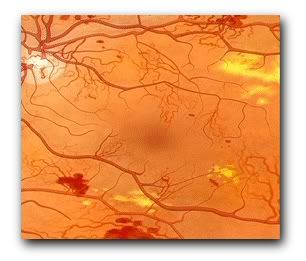
Hypertension and Diabetes and Eye Damage
Tuesday, August 28, 2012
Minorities at Greater Risk for Visual Impairments
 |
| Graph from the Centers for Disease Control |
Thursday, July 12, 2012
Study Finds Why Hypertension and Diabetes Impair Vision

Thursday, May 24, 2012
CLs Change Color When Sugar Levels Change
"For the millions of Americans with diabetes, the inconvenient and often painful method of testing blood sugar levels is a way of life. But research and innovative product design by scientists at The University of Akron may eliminate the need for needle pricks, blood draws, or other invasive devices," according to a University of Akron post. "Researchers have developed a contact lens that senses glucose which is the blood sugar in tears, the natural fluid that bathes the eye. If sugar is not being metabolized properly and glucose concentration builds up in the body, the contact lens will detect a problem and change color." Read more.
Thursday, January 5, 2012
More News on the Microsoft CL for Monitoring Diabetes

Sunday, November 20, 2011
Diabetes Not Taking Toll on Eyesight as It Once Did
Medscape reports that "the age-adjusted percentage of people with diabetes reporting visual
impairment (VI) dropped substantially between 1997 and 2010, from 23.7%
in 1997 to 16.7% in 2010, according to National Health Interview Survey
(NHIS) data from the Centers for Disease Control and Prevention, published in the November 18 issue of Morbidity and Mortality Weekly Report." Read more.
Saturday, October 29, 2011
Prevent Blindness America Launches Anti-Diabetes Campaign in November
More than 25 million Americans have diabetes. In addition to being
the leading cause of kidney failure and non-traumatic lower limb
amputations, it is the leading cause of new cases of blindness in those
ages 20 and over. As part of November's Diabetic Eye Disease Awareness Month, Prevent Blindness America is launching its new "Live Right, Save Sight!"
campaign. The goal of the new program is to educate the public on
diabetes and its potential effect on vision, as well as healthy choices
they can make today to save sight in the future. Live Right, Save
Sight! also provides free information including risk factors, treatment
options and Medicare benefits as well as a dedicated web page at
preventblindness.org/diabetes. Read more.
Wednesday, August 17, 2011
Diabetes and Hypertension Leading to Glaucoma

Subscribe to:
Posts (Atom)