Showing posts with label Visually impaired. Show all posts

Monday, November 3, 2014

Video Game Key to Helping Visually-Impaired Children

“Researchers are to begin testing a new computer game which they hope could hold the key to helping visually-impaired children lead independent lives,” says Medical News Today. “Developed by a team of neuroscientists and video game designers from the University of Lincoln, UK, and the WESC Foundation, one of the UK's leading specialist schools for visually impaired children, the Eyelander game features exploding volcanoes, a travelling avatar and animated landscapes. The idea is to improve the functional vision of children who have sight issues due to a brain injury rather than damage to the eye itself. Functional vision is used to perform everyday tasks such as safely crossing the road or finding a book on a bookshelf, but when the visual pathways between the brain and the eyes become damaged, the messages aren't correctly relayed and the visual field becomes reduced.” Read more.

Friday, September 12, 2014

Education Helps Get the Visually Impaired to Work

"A brand new survey has revealed that education is important for getting the visually impaired into work. This challenges the current situation in which partially sighted students are now exempt from several upper secondary school subjects," according to a Science Daily post. "A new wide-ranging survey carried out by SINTEF has gathered the responses of nearly 1000 visually impaired people. The project 'Med jobb i sikte' (Work in mind) has included the first major survey of its kind since 1994. Whereas in previous surveys the emphasis was on facilitation and support schemes, focus has now turned to the factors that help and hinder the visually impaired from getting jobs." Read more.

Wednesday, August 20, 2014

“Enactive Torch” Helps Visually Impaired

“University of Cincinnati experiment aimed at this diverse and growing population could spark development of advanced tools to help all the aging baby boomers, injured veterans, diabetics and white-cane-wielding pedestrians navigate the blurred edges of everyday life,” according to a Medical News Today post. “These tools could be based on a device called the Enactive Torch, which looks like a combination between a TV remote and Captain Kirk's weapon of choice. But it can do much greater things than change channels or stun aliens. Luis Favela, a graduate student in philosophy and psychology, has found the torch enables the visually impaired to judge their ability to comfortably pass through narrow passages, like an open door or busy sidewalk, as good as if they were actually seeing such pathways themselves.” Read more.

Thursday, July 31, 2014

New Reading System Helps Visually Impaired ‘See’ Graphics

“People who are blind can now read more than just words, such as graphs and graphics, following the development of an affordable digital reading system by Curtin University researchers,” goes the post in Medical News Today. “Opening up new career paths and educational opportunities for people with vision impairment, the system combines a number of pattern recognition technologies into a single platform and, for the first time, allows mathematics and graphical material to be extracted and described without sighted intervention. Senior Lecturer Dr. Iain Murray and Ph.D. student Azadeh Nazemi of Curtin's Department of Electrical and Computing Engineering developed the device to handle the extraordinary number of complex issues faced by the vision impaired when needing to read graphics, graphs, bills, bank statements and more.” Read more.

Friday, July 4, 2014

Smart Glasses for the Visually Impaired

Oxford University researchers are measuring how their smart glasses can help people with limited vision navigate and avoid walking into obstacles, says a university press release. "The idea of the smart glasses is to give people with poor vision an aid that boosts their awareness of what's around them – allowing greater freedom, independence and confidence to get about, and a much improved quality of life," says Dr. Stephen Hicks of the Nuffield Department of Clinical Neurosciences at the University of Oxford, who is leading the development of the glasses. 'We eventually want to have a product that will look like a regular pair of glasses and cost no more than a few hundred pounds - about the same as a smart phone,' he adds.

The smart glasses consist of a video camera mounted on the frame of the glasses; a computer processing unit that is small enough to fit in a pocket; and software that provides images of objects close-by to the see-through displays in the eyepieces of the glasses. Read more.

Goodnight Moon Goes 3-D for the Visually Impaired

“Goodnight room, goodnight moon. Goodnight cow jumping over the moon.” That's the start of a University of Colorado Boulder post. A children’s feel-good classic, Goodnight Moon, could get a shot in the arm. A CU-Blouder team printed the first 3D version of it, allowing visually impaired children and their families to touch objects in the story as they read it aloud. With more than 40 million copies in print, the Margaret Wise Brown story was a logical first choice for CU-Boulder’s Tactile Picture Books Project. CU-Boulder computer science Assistant Professor Tom Yeh and his team now are using the same techniques to print other popular children’s books, including Harold and the Purple Crayon and The Very Hungry Caterpillar. Read more.

Saturday, June 15, 2013

‘Morse-Code’ Type Device Could Help Visually Impaired

“In the near future, a buzz in your belt or a pulse from your jacket may give you instructions on how to navigate your surroundings.” That’s the tease from Medical News Today. “Think of it as tactile Morse code: vibrations from a wearable, GPS-linked device that tell you to turn right or left, or stop, depending on the pattern of pulses you feel. Such a device could free drivers from having to look at maps, and could also serve as a tactile guide for the visually and hearing impaired. Lynette Jones, a senior research scientist in MIT's Department of Mechanical Engineering, designs wearable tactile displays. Through her work, she's observed that the skin is a sensitive - though largely untapped - medium for communication.” Read more.

Thursday, November 15, 2012

Communications Website for the Visual Impaired

Americans who have combined vision and hearing loss can now access technology that will allow them to connect with people around the corner and across the world by logging on to www.iCanConnect.org. The newly launched website accommodates users with low vision, people who use screen readers and features video that is both audio-described and closed captioned. From screen enlargement software and videophones, to off-the shelf products that are accessible or adaptable, www.iCanConnect.org offers a vast array of new communications technology. Assessment, training and equipment are available free of charge to those who meet federal eligibility guidelines.The www.iCanConnect.org launch advances the iCanConnect campaign mission to raise awareness about the National Deaf-Blind Equipment Distribution Program (NDBEDP). Mandated by the 21st Century Communications and Video Accessibility Act (CVAA), the Federal Communications Commission (FCC) established this new program to ensure every person with combined hearing and vision loss has access to modern communications tools and the training necessary to use them. Perkins and the Helen Keller National Center in New York City are overseeing the iCanConnect campaign.

Wednesday, May 30, 2012

Virtual Reality Goggles Help Visually impaired
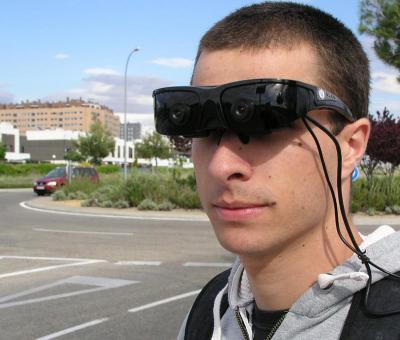
"Researchers at Universidad Carlos III in Madrid (UC3M) have developed a system that can be built into virtual reality goggles that help patients with moderate visual impairment move around their surroundings," reports Medical News Today. "The application detects the distance and shape of objects and interacts with the user by means of a simple color code." Read more.

Saturday, September 24, 2011

Studying Link between Poor Vision and Depression

"More than a third of blind and visually-impaired people could also suffer from depression, it has been claimed," according  a BBC post. "Researchers at Cardiff School of Optometry [Wales, Great Britain] are launching what they believe is the UK's first clinical study into the problem. Anyone with low vision can fill in questionnaires at opticians or optometrists in Wales in the next year. If necessary, they will be offered immediate treatment. The Depression in Visual Impairment Trial (DEPVIT) is being conducted by the School of Optometry in conjunction with the Guide Dogs for the Blind Association." Read more.